
American Whiskey vs Bourbon: What Every Buyer in Phoenix Should Know
If you’ve ever stood in a Phoenix liquor store staring at two bottles, one labeled “American Whiskey” and one labeled “Bourbon,” and wondered what the actual difference is, you’re not alone. Bourbon is American whiskey, but not all American whiskey is bourbon. Understanding that distinction and knowing the federal rules behind each category will make you a smarter buyer, a better host, and someone who genuinely knows what’s in their glass. At Uncommon Spirits, we believe every whiskey drinker deserves to know exactly what they’re pouring.
What Is American Whiskey? A Broad Category with Real Rules
American whiskey is the umbrella term covering every whiskey legally produced in the United States. That includes bourbon, rye, Tennessee whiskey, wheat whiskey, malt whiskey, and corn whiskey. Each of these sub-categories has its own set of government-regulated production standards under the Alcohol and Tobacco Tax and Trade Bureau (TTB), which enforces whiskey alcohol rules in the U.S.
To be classified as any type of American whiskey, a spirit must meet all of the following federal requirements:
- Distilled from a fermented grain mash
- Produced in the United States
- Distilled to no more than 190 proof (95% ABV)
- Aged in oak containers
- Bottled at no less than 80 proof (40% ABV)
These baseline whiskey alcohol rules apply across every sub-category. From there, individual types layer on additional requirements, and that is where bourbon enters the conversation.
View our whiskeys crafted right here in Phoenix, Arizona.
What Makes Bourbon Different? The Bourbon Definition USA Buyers Should Know
Bourbon is a specific type of American whiskey that must meet a stricter set of legal criteria. Here is the bourbon definition USA federal law actually mandates:
- 51% corn minimum – The grain bill must contain at least 51% corn. The remaining grains, typically barley, rye, or wheat, shape the flavor profile from sweet and approachable to bold and spicy.
- New charred oak barrels – Bourbon must always be aged in new, charred oak containers. Unlike Scotch whisky which reuses casks, bourbon requires a fresh barrel every single time. That char delivers bourbon’s signature vanilla, caramel, and oak character.
- Distillation proof limits – Bourbon must be distilled to no more than 160 proof (80% ABV) and entered into the barrel at no more than 125 proof (62.5% ABV).
- Zero additives – Nothing may be added to alter color or flavor. No caramel coloring, no flavor syrups, no shortcuts. Water is the only acceptable addition.
- No minimum age – Contrary to popular belief, standard bourbon has no minimum aging requirement, though it must always be aged inside the United States.
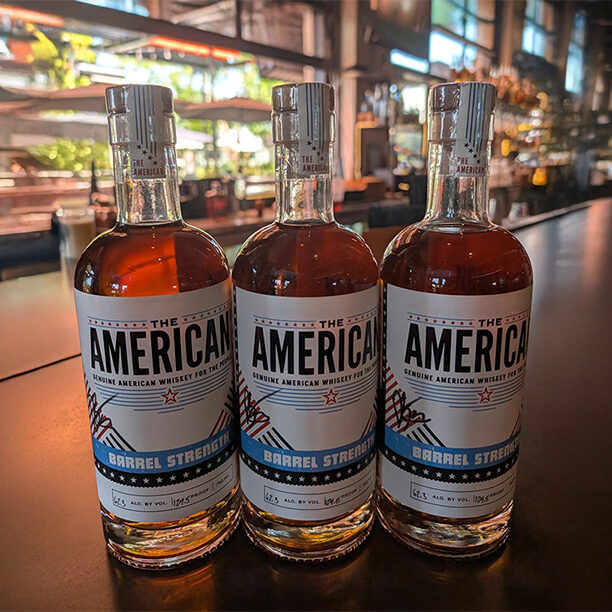
Try The American, our flagship expression of bold, purposeful American whiskey.
What Is Straight Bourbon Whiskey?
When a label reads “straight bourbon whiskey,” that signals a meaningful upgrade in production standards. Straight bourbon whiskey must meet all standard bourbon requirements plus the following:
- Aged for a minimum of two years in new charred oak barrels
- Age must be stated on the label if the whiskey is under four years old
- No blending with neutral grain spirits or other whiskey types permitted
- No added coloring, flavoring, or blending material of any kind allowed
The “straight” designation is a signal of quality and transparency. It tells you the distiller did not cut corners. What is in the bottle is exactly what came out of that barrel, aged properly and bottled honestly. For whiskey buyers in Phoenix who want to know exactly what they are drinking, the straight bourbon designation is one of the most reliable markers on any label.
See our barrel strength, a Gold Medal winner at the 2025 New York International Spirits Competition.
Whiskey Types Explained: How Bourbon Fits the Bigger Picture
To put the difference between bourbon and American whiskey in full context, here is a quick breakdown of the main whiskey types explained.
| Whiskey Type | Primary Grain | Key Rule | Flavor Profile |
|---|---|---|---|
| Bourbon Whiskey | 51%+ Corn | New charred oak, no additives | Sweet, vanilla, caramel, oak |
| Straight Bourbon | 51%+ Corn | 2+ year age, no blending | Rich, structured, full-bodied |
| Rye Whiskey | 51%+ Rye | New charred oak | Spicy, dry, bold |
| Tennessee Whiskey | 51%+ Corn | Bourbon rules + charcoal filtering | Smooth, mellow, slightly sweet |
| Corn Whiskey | 80%+ Corn | No new charred oak required | Light, sweet, unaged character |
| Wheat Whiskey | 51%+ Wheat | New charred oak | Soft, mild, approachable |
| American Craft Whiskey | Varies | Small-batch, independent | Varies by distillery and region |
Read about Arizona vs Kentucky bourbon and how desert heat changes everything.
Why Phoenix Buyers Are Paying More Attention to These Labels
Phoenix’s whiskey scene has matured rapidly. Buyers here are no longer just grabbing what is familiar. They are reading labels, asking questions at tasting events, and making intentional choices. Here is why the difference between bourbon and American whiskey matters in this market:
- Value is label-dependent. A whiskey labeled “American Whiskey” can legally be a blend with fewer restrictions than straight bourbon. That does not make it inferior, but it is different, and price should reflect that difference.
- Local craft is booming. Phoenix distilleries are producing both bourbon and broader American whiskey expressions. Knowing what you are buying helps you appreciate the craft and the challenge behind each bottle.
- Gifting requires confidence. When selecting a bottle for a client, friend, or tasting event, knowing whether you are choosing a straight bourbon, barrel strength expression, or craft whiskey blend tells the story before the pour.
Find us near you at local Arizona retailers and restaurants carrying Uncommon Spirits.
What to Look for on the Label
When you pick up a bottle of whiskey in Phoenix, a few simple checks will tell you a great deal about what you are holding:
- Category declaration – Federal law requires the whiskey type to appear on the label, such as Bourbon Whiskey, Straight Bourbon Whiskey, or American Whiskey.
- Age statement – If it is a straight bourbon aged under four years, an age statement is legally required. No age statement on a straight bourbon means it is at least four years old.
- Proof – Standard bottlings are typically 80 to 90 proof. Barrel strength expressions can reach 110 to 130 proof or higher. Higher proof is a style preference, not a quality guarantee.
- No additives language – On bourbon, this is always true by law. Some American whiskey blends may contain additives, so look for explicit language when it matters to you.
- Distillery location – For Phoenix buyers who support local, look for “Distilled in Arizona” or the distillery’s physical address on the label.
Explore our Signature Series for a fully customized private barrel experience.
American Craft Whiskey in Phoenix: A New Standard
The rise of American craft whiskey distilleries in Phoenix is a movement toward transparency, intentionality, and quality. Small-batch producers in the desert Southwest are taking the same federal framework that governs every American whiskey and using it as a creative foundation rather than a ceiling.
At Uncommon Spirits, every bottle is built on the principle of Verum Intus, which means the truth is inside. That means no shortcuts on grain selection, no compromises on barrel quality, and no padding with additives. Whether the expression is classified as bourbon or a broader American whiskey, the standard is the same: it has to be worth your glass.
The desert climate in Arizona also plays a role no federal regulation can replicate. Phoenix’s extreme heat causes barrels to expand and contract dramatically, pulling spirit into the wood faster and extracting flavor compounds at an accelerated pace. The result is a whiskey with depth and character that a more temperate climate might take twice as long to develop.
Learn why Phoenix distilleries are booming and what the desert whiskey movement really means.
Hosting a Whiskey Tasting in Phoenix? Here’s How to Use This Knowledge
If you are planning a whiskey tasting, whether at home, for a business event, or at a private gathering, leading with category education is a great way to elevate the experience. Follow this simple three-bottle structure:
- Start with a broad American whiskey to show guests what the baseline category tastes like without the stricter bourbon requirements.
- Move to a straight bourbon and let the structure, sweetness, and new oak influence contrast clearly with the first pour.
- Finish with a barrel strength expression for the most intense, uncut version of the spirit, and save the most discussion for this final glass.
This three-bottle format turns a tasting into a lesson, and lessons make for memorable evenings.
Plan your tasting and let our team help you create something truly uncommon in Phoenix.
Conclusion: Know Your Whiskey, Own Your Pour
The difference between bourbon and American whiskey is not just a technicality. It is a window into how American spirits are made, regulated, and valued. Bourbon is a specific, rule-bound, and celebrated expression of American whiskey culture. Straight bourbon whiskey takes that a step further with aging requirements and a strict no-additives commitment. American craft whiskey, in all its regional variety, is where innovation and creativity live.
For Phoenix buyers, this knowledge is genuinely useful. Whether you are buying for yourself, gifting a bottle, stocking a bar, or hosting a tasting, understanding what is on the label makes every pour more intentional. The whiskey in your glass has a story rooted in federal law, grain selection, barrel craft, and climate. In Phoenix, a new chapter of that story is being written right now. Make sure you are reading it.
Want to know more about the people and passion behind our bottles? About us and discover the story that drives every pour.
Ready to order, ask questions, or set up a tasting event in Phoenix? Contact us and let’s start the conversation.
Frequently Asked Questions
Q1. What is the main difference between bourbon and American whiskey?
Bourbon is a legally defined sub-category of American whiskey requiring 51% corn, new charred oak barrels, and zero additives allowed.
Q2. Does bourbon have to be made in Kentucky?
No. Bourbon can be legally produced anywhere in the United States, including Arizona, as long as it meets all federal TTB production requirements.
Q3. What does straight bourbon whiskey mean on a label?
It means the bourbon was aged at least two years in new charred oak with no additives, blending agents, or artificial coloring of any kind.
Q4. Is American craft whiskey the same as bourbon?
Not always. Craft whiskey refers to small-batch production style. It may or may not meet the specific legal standards required to carry the bourbon label.
Q5. Why does Phoenix produce good whiskey despite the desert heat?
Arizona’s extreme heat accelerates barrel aging, causing rapid wood interaction that builds deep flavor and character faster than cooler climates allow.